
Format hub · ranked by composite · 21 September 2026
Best free AI SEO course
Best free AI SEO course, checked 21 September 2026: AI SEO: Mastering Generative Engine Optimization (GEO). Runner-up Generative Engine Optimization (GEO): Get Cited by AI. Cheapest credible option is either of them, since every program on this hub costs nothing. 7 programs are ranked here and 11 are listed without a rank because the public evidence is too thin to score with confidence. The top pick leads on evidence rather than marketing: a tier A rating on Coursera, a published learner count, and eight of the thirteen curriculum flags confirmed, including GEO and LLM citations. Rank order is composite score order on this page, as on every page.
Which free AI SEO course is best? 7 ranked and 11 listed without a rank, out of 45 English-language programs in the dataset; relevance floor 0.6; checked 21 September 2026.
How was this ranking calculated?
6 weighted dimensions (satisfaction 22%, volume 13%, recency 15%, sentiment 20%, transparency 20%, completeness 10%) score each of the 45 English-language programs from 0 to 100 under rubric v1, locked 17 September 2026 and checked 21 September 2026. Rank order is score order on every page; ties break on name and nothing is featured.
Ranked by the full composite (all six dimensions, evidence ladder applied). Ties break on name. Programs with low confidence are listed below the ranked list without a rank number (decision 11). Full method: AI SEO course scoring methodology.
| Dimension | Weight | What it measures |
|---|---|---|
| Satisfaction | 22% | Course-level platform rating, shrunk toward that platform's mean with a Bayesian prior of 10 reviews. A shrunk rating of 3.5 scores 0 and 5.0 scores 100. Platforms with fewer than two rated programs use the dataset mean as the prior. Provider-level ratings (Trustpilot for the company, instructor profile scores) never count. |
| Volume | 13% | Log-scaled review count (saturates at 100) and member or enrolment count (saturates at 3000), averaged over whichever of the two is published. Provider-level student totals are not counted. |
| Recency | 15% | Months between the observation cutoff and the latest dated evidence (content update, launch, cohort date, price change, review, independent discussion), decaying linearly to 0 over 12 months. |
| Sentiment | 20% | Praise-versus-complaint balance over independent public discussion and attributed review excerpts, labelled by a derived-themes pass (claude-haiku-4-5): each item gets a stance (positive 1, mixed and neutral 0.5, negative 0) and themes from a fixed vocabulary; the score is the mean stance. Provider-authored posts and syndicated copies are excluded. No review text is stored. |
| Transparency | 20% | Seven binary checks: price on the provider's own site, refund policy published, instructor named with a public track record, curriculum published, module or lesson count published, member or enrolment count published, testimonials or reviews dated. Score is checks met out of 7 for a paid program and out of 6 for a free one, where the refund check does not apply (decision 11). |
| Completeness | 10% | Share of the 67 tracked attributes that are confirmed (a value with url and date, or an explicit no) rather than unverified. |
The score measures public evidence about a program (what is published, what learners say, how current it is), not teaching quality. A missing rating is never scored as 0, ratings are never blended across platforms, and no rating is ever invented. "No public rating (checked on date)" is rendered as a fact.
Low-confidence programs are listed, not ranked. On every hub a program whose confidence label is "low" (evidence Tier C or D, or under 60% of attributes confirmed) appears in a separate "Insufficient public evidence" block below the ranked list, with its facts, its composite for reference and a link to its record, but no rank number. The ranked list and its ItemList schema contain medium and high confidence programs only. The homepage and /courses/ tables show every program with its confidence label.
No paid placement. No program has paid, or can pay, to be listed, ranked or featured. Rank order is score order on every page. Every statistic with its denominator: AI SEO course findings.
Which programs rank as the best free AI SEO course?
7 of 45 English-language programs at medium or high confidence are ranked below in composite order, rubric v1; 11 more match this hub at low confidence and are listed without a rank (checked 21 September 2026). Rank order is score order, no program can pay to be listed, and every price and rating carries its own date.
- 1
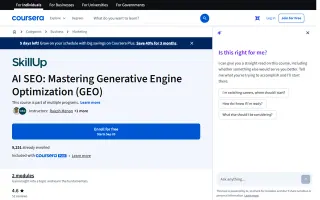 Self-paced Free (20 Sep 2026) 4.6 of 5 from 50 reviews on Coursera (18 Sep 2026) 9,190 learners (18 Sep 2026)
First on a composite of 83, checked 18 September 2026. It sits at evidence tier A: 4.6 from 50 ratings on Coursera, plus a published figure of 9,190 learners. The confirmed curriculum covers GEO, LLM citations, entity SEO, structured data and AI visibility measurement, which is wide for something that costs nothing. Reviewer themes run to depth and beginner friendliness. Suits someone new to AI search who wants a certificate without paying. No live calls, no community.
- 2
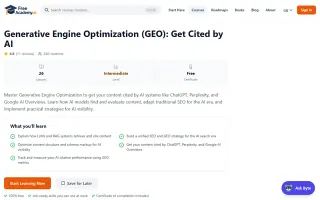 Self-paced Free (18 Sep 2026) 4.8 of 5 from 11 reviews on FreeAcademy (18 Sep 2026) 631 students (18 Sep 2026)
Second on 81.1, and the widest confirmed curriculum on this hub: ten of the thirteen flags, including brand mentions and PR that most free courses skip. The rating is 4.8 from 11 reviews on FreeAcademy, which is tier A but a thin sample. Published size is 631 students. A community is included and a certificate is issued. Checked 18 September 2026. Good for a beginner who wants breadth in one sitting.
- 3
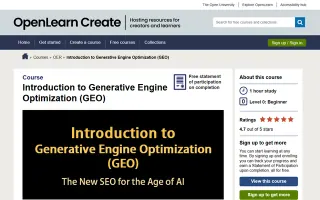 Free manual Free (18 Sep 2026) 4.7 of 5 from 7 reviews on OpenLearn Create (18 Sep 2026)
Third on 72.2. Rated 4.7 from 7 reviews on OpenLearn Create, which puts it at tier B: real reviews, too few to lean on hard. No enrolment count is published. Eight curriculum flags are confirmed, including local AI SEO, which only a minority of the directory covers. Praise themes centre on beginner pacing and practical tools. Format is a free manual rather than video, so it suits readers who prefer to skim and take notes. Checked 18 September 2026.
- 4
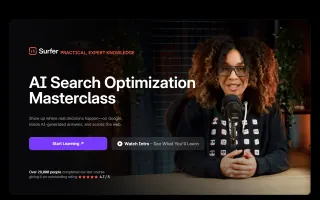 Self-paced Free (18 Sep 2026) 4.8 of 5 from 9 reviews on Udemy (18 Sep 2026) 570 students (18 Sep 2026)
Fourth on 71.3, and the most practical of the set for working practitioners. Eleven curriculum flags are confirmed, including AI crawler access and local AI SEO. Rating is 4.8 from 9 reviews on Udemy (tier B), with 570 students published. It is a vendor academy course, so expect the vendor's tooling in the examples. Aimed at agencies and in house teams rather than beginners. Checked 18 September 2026.
- 5
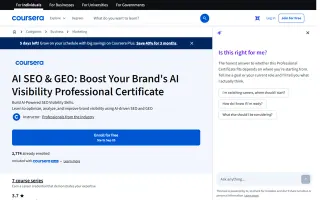 AI SEO and GEO: Boost Your Brand's AI Visibility Professional Certificate 63.1 Medium confidence Tier BCertificate program Free (20 Sep 2026) 3.7 of 5 from 7 reviews on Coursera (18 Sep 2026) 2,756 members (18 Sep 2026)
Fifth on 63.1. The rating is 3.7 from 7 reviews on Coursera, lower than anything above it, which is what pulls the score down. Size is published at 2,756 members and a refund policy is on record as 7-day one-time purchase policy; subscription refunds generally not provided; 14-day Coursera Plus Annual policy. Seven flags confirmed, including AI crawler access and AI workflows. It is a certificate track aimed at beginners, so the draw is the credential path rather than depth. Checked 18 September 2026.
- 6
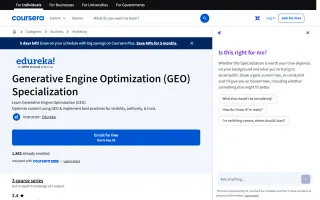 Certificate program Free (20 Sep 2026) 3.4 of 5 from 11 reviews on Coursera (18 Sep 2026) 1,846 members (18 Sep 2026)
Sixth on 61.1. Tier A evidence, 3.4 from 11 ratings on Coursera, and the low rating is the reason it sits here rather than higher. Nine flags are confirmed, a wider spread than the score suggests, and 1,846 members are published. Refund policy on record: 7-day subscription refund period or before earning a certificate; Coursera Plus Annual has 14 days. It is a multi-course specialization pitched at beginners, in house SEOs and enterprise teams. Worth a look if you want structure. Checked 18 September 2026.
- 7
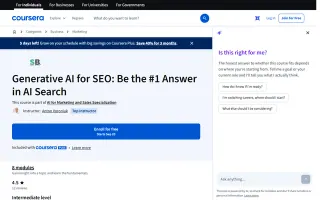 Self-paced Free (18 Sep 2026) 4.5 of 5 from 12 reviews on Coursera (18 Sep 2026)
Seventh on 43.8, the lowest on this hub. The rating is decent at 4.5 from 12 ratings on Coursera, but only two curriculum flags are confirmed: traditional SEO and AI workflows. No GEO, no LLM citations, no measurement on record. No enrolment count is published either. Treat it as a short prompt-and-workflow session for an in house SEO who already knows the fundamentals, not a course on AI search visibility. Checked 18 September 2026.
Insufficient public evidence: 11 programs listed, not ranked
Below the ranked table sits an insufficient public evidence block. Those 11 programs match this hub but carry a low confidence label, usually because no course-level rating exists or the provider publishes little that can be checked. They are listed with their facts and composite score for reference, and deliberately left out of the rank order. A low label is about the public record, not about the teaching.
| Program | Format | Price | Rating | Composite (reference) | Tier | Why it is not ranked | Checked |
|---|---|---|---|---|---|---|---|
| Answer Engine Optimization (AEO) Course | Self-paced | Free | No public rating | 67.5 | CLow | no course-level rating; independent discussion only (evidence Tier C) | 18 Sep 2026 |
| AEO Fundamentals | Self-paced | Free | No public rating | 63.1 | CLow | no course-level rating; independent discussion only (evidence Tier C) | 17 Sep 2026 |
| AI SEO course for local businesses | Self-paced | Free | No public rating | 62.0 | DLow | no course-level rating and fewer than 3 independent discussion URLs (evidence Tier D) | 21 Sep 2026 |
| AI SEO Operators | Community | Free | No public rating | 57.7 | CLow | no course-level rating; independent discussion only (evidence Tier C); 49% of tracked attributes confirmed (under 60%) | 18 Sep 2026 |
| Learning AI Search: The Free AI Search Optimization Roadmap | Free manual | Free | No public rating | 56.7 | CLow | no course-level rating; independent discussion only (evidence Tier C) | 18 Sep 2026 |
| GEO Academy | Self-paced | Free | No public rating | 54.4 | DLow | no course-level rating and fewer than 3 independent discussion URLs (evidence Tier D) | 18 Sep 2026 |
| Implementing AEO With HubSpot | Certificate program | Free | No public rating | 53.5 | DLow | no course-level rating and fewer than 3 independent discussion URLs (evidence Tier D) | 18 Sep 2026 |
| AI Visibility Essentials with Semrush | Self-paced | Free | No public rating | 46.9 | DLow | no course-level rating and fewer than 3 independent discussion URLs (evidence Tier D) | 18 Sep 2026 |
| Introduction to GEO | Self-paced | Free | No public rating | 43.5 | CLow | no course-level rating; independent discussion only (evidence Tier C); 58% of tracked attributes confirmed (under 60%) | 18 Sep 2026 |
| The AI Search Manual | Free manual | Free | No public rating | 43.3 | DLow | no course-level rating and fewer than 3 independent discussion URLs (evidence Tier D) | 18 Sep 2026 |
| SEO Enablement: Answer Engine Optimization (AEO) | Free manual | Free | No public rating | 26.8 | DLow | no course-level rating and fewer than 3 independent discussion URLs (evidence Tier D); 55% of tracked attributes confirmed (under 60%) | 18 Sep 2026 |
How many free AI SEO courses are in the directory?
18 of 45 English programs are free, checked 21 September 2026, with 2 cases unconfirmed either way. Paid programs with a published price account for 25 of 45. So free is roughly two in five of the English set, not a fringe corner of it.
Do free courses teach less than paid ones?
Free programs average 7.7 across 18 programs, against 7.1 over 25 paid ones, checked 21 September 2026. On GEO the gap is similar: 11 of 18 free programs teach it versus 14 of 25 paid. Coverage is not what money buys.
Which topics are covered on almost every free course?
LLM citations show up in 16 of 18 free programs and AI visibility measurement in 15 of 18, checked 21 September 2026. The thin spots are AI crawler access (9 of 18) and local AI SEO (6 of 18). Check the technical side before assuming it is covered.
Can a free course still be well evidenced?
10 of 45 English programs sit at evidence tier A, meaning a public rating with ten or more reviews, checked 21 September 2026. Four of the 7 ranked programs on this page hit that bar. Tier D, nothing public at course level, covers 16 of 45. Price and evidence quality are not the same axis.
Do free courses hand out certificates?
27 of 45 English programs issue a certificate, checked 21 September 2026, and all 7 ranked here do. The catch: 0 of 27 certificates name an accrediting body. Treat the document as proof you finished something, not as a recognised qualification.
Frequently asked questions
Is the top pick free forever, or a free trial?
It is listed as free to enrol on Coursera as of 21 September 2026. Pricing models move, so the checked-on date on the record is the fact that matters. If the model changes, the record changes at the next refresh.
Why are ten programs listed but not ranked?
They carry a low confidence label, which usually means no course-level public rating and little published detail. The rule here is to list them with their facts and composite score, and to leave them out of the rank order rather than guess.
What does the composite score measure?
Public evidence about a program, across six dimensions. Satisfaction and review volume, how recent the reviews are, review sentiment, how much the provider publishes, and how complete the record is. It does not measure teaching quality, and no provider can pay to be listed or to move up.
Better to start free or pay straight away?
Start free. Free programs match paid ones on curriculum breadth in this dataset, and two of the courses ranked here carry tier A ratings. Pay once you know which specific gap needs filling.
How often are these facts rechecked?
Every fact carries a checked-on date, currently 21 September 2026 for the directory-wide statistics. Ratings and prices are re-pulled on each refresh, and the rank order follows the new scores.